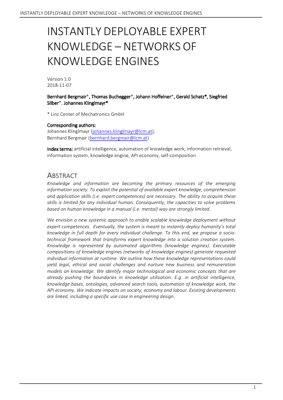
Networks of Knowledge Engines: A Framework for Scalable Expert Knowledge Deployment
A socio-technical framework proposing automated knowledge engines and their networks to enable scalable, instant deployment of expert knowledge for solving individual challenges.
Home »
Documentation »
Networks of Knowledge Engines: A Framework for Scalable Expert Knowledge Deployment
1. Introduction
The paper identifies a fundamental shift in value creation from agricultural and industrial production towards services and, more recently, information- and knowledge-based services. Information and knowledge are posited as the primary resources of the emerging knowledge society. However, a critical bottleneck is identified: the human capacity to acquire and apply expert knowledge is inherently limited, making scalable problem-solving based on deep knowledge a significant challenge.
Current solutions, such as searching databases or consulting human experts, are constrained by findability, availability, and cost. The authors argue this limits humanity's ability to leverage its collective knowledge for novel, individual problems, especially those without pre-existing solutions or those requiring innovative combinations of knowledge.
2. Networks of Knowledge Engines
This section introduces the core conceptual framework proposed to overcome the limitations outlined in the introduction.
2.1 Vision
The authors envision a new socio-technical framework to enable scalable knowledge utilization. The ultimate, albeit utopian, goal is to allow everyone to instantly deploy "humanity’s total knowledge in full depth for each individual challenge." This framework is presented as a guiding course for the age of artificial intelligence, moving beyond simple information retrieval to dynamic solution creation.
The proposed mechanism involves transforming expert knowledge into automated algorithms, termed Knowledge Engines. These engines can be composed into executable networks at runtime to generate requested, individualized information or solutions. The paper acknowledges this vision will raise legal, ethical, social, and new business model challenges.
3. Core Insight & Analyst Perspective
Core Insight
The paper's radical proposition isn't just another AI tool; it's an architectural blueprint for a post-expertise economy. It correctly diagnoses that the bottleneck of the knowledge society is not data storage (we have petabytes) but the latency and accessibility of applied competence. Their vision to commoditize deep expertise via composable "Knowledge Engines" aims to do for expert problem-solving what APIs did for software functionality—democratize and monetize it at scale. This aligns with trends observed in research like the work on Neuro-Symbolic AI from MIT-IBM Watson AI Lab, which seeks to combine neural networks' pattern recognition with symbolic systems' reasoning, a likely technical path for building such engines.
Logical Flow
The argument flows compellingly from problem to solution: 1) Knowledge is the new capital, 2) Human cognitive bandwidth is the limiting factor, 3) Therefore, we must externalize and automate the application of knowledge, not just its storage. The leap from "knowledge base" to "knowledge engine" is crucial—it shifts the paradigm from passive retrieval to active, context-aware generation. This mirrors the evolution from databases (SQL) to function-as-a-service (FaaS) platforms like AWS Lambda, where executable logic is the fundamental unit.
Strengths & Flaws
Strengths: The framework is brilliantly interdisciplinary, touching on computer science, economics (API economy), and sociology. It identifies key enabling trends (AI, ontologies, automation of knowledge work) correctly. The emphasis on a socio-technical system is prescient, acknowledging that technology alone fails without cultural and business model adaptation.
Critical Flaws: The paper is dangerously light on the how. It hand-waves the monumental challenge of formally encoding tacit, experiential expert knowledge into deterministic "engines." As highlighted in the seminal paper "Challenges for Knowledge Representation via Ontologies" by Staab & Studer, knowledge acquisition remains the "bottleneck of bottlenecks." The vision also underestimates the combinatorial explosion and validation nightmare of dynamically composed engine networks. Who is liable when a network-generated solution fails? The governance model is embryonic.
Actionable Insights
For enterprises: Start piloting this now by treating internal expert workflows not as documents to be read, but as algorithms to be encapsulated. Build internal "Expertise APIs." For researchers: Focus less on general AI and more on domain-specific knowledge formalization. The real breakthrough will come from fields like mechanical engineering or legal compliance, where rules are more well-defined. Partner with standards bodies (like W3C for ontologies) early to avoid a Tower of Babel of incompatible knowledge engines. The first-mover advantage here is not in having the best engine, but in defining the composition protocol.
The core technical proposition involves Knowledge Engines ($KE$) as functional units. A Knowledge Engine can be formally represented as a function that maps a specific problem context ($C$) and available input data ($I$) to a solution or knowledge output ($O$), potentially utilizing an internal knowledge model ($M$).
$KE_i: (C, I, M_i) \rightarrow O_i$
A Network of Knowledge Engines ($NKE$) is a directed graph composition of multiple $KE$s, where the output of one engine can serve as input or context for another. The composition ($\Phi$) is dynamic and determined by a runtime orchestrator based on the problem request ($R$).
$NKE(R) = \Phi(KE_1, KE_2, ..., KE_n | R)$
The orchestrator's logic must handle matching, sequencing, and data flow, akin to a workflow engine but for cognitive processes. This requires a rich metadata layer for each $KE$, describing its capabilities, input/output schemas, preconditions, and domain.
5. Conceptual Results & System Architecture
While the PDF does not present quantitative experimental results, it outlines a conceptual architecture and its expected outcomes:
System Architecture Diagram Description
The envisioned system architecture would logically consist of several layers:
Knowledge Representation Layer: Contains the formalized Knowledge Engines ($KE$s), each encapsulating a specific domain algorithm or rule set. These could range from a finite element analysis solver to a legal clause interpreter.
Orchestration & Composition Layer: The "runtime" brain of the system. It accepts a user's problem query ($R$), decomposes it, identifies relevant $KE$s from a registry, and dynamically constructs an executable workflow ($NKE$). This layer would utilize ontologies for semantic matching.
Execution Layer: Manages the actual invocation of the composed $KE$s, handling data passing, state management, and error handling.
Interface Layer: Provides APIs and user interfaces for submitting challenges and receiving synthesized solutions.
Governance & Economy Layer: Manages access control, usage tracking, billing, and quality/trust metrics for $KE$s, enabling the "API economy" for knowledge.
Expected Outcome: The primary result is not a single answer but a solution creation process. For a complex challenge like "design a lightweight bracket for a drone under specific stress conditions," the system would not retrieve a blueprint. Instead, it would compose engines for material selection, stress simulation, topology optimization, and manufacturing cost analysis, running them in sequence to generate a novel, validated design proposal.
6. Analysis Framework: Engineering Design Use Case
The paper mentions a use case in engineering design. Here is a fleshed-out, no-code example of how the framework would be applied:
Challenge: "Optimize the thermal management system for a new high-performance CPU chip layout."
Traditional Approach: A thermal engineer manually uses simulation software (e.g., ANSYS), interprets results, makes design adjustments (e.g., heat sink fin geometry), and re-runs simulations iteratively—a slow, expertise-intensive loop.
Knowledge Engine Network Approach:
Query Parsing: The orchestrator decomposes "optimize thermal management" into sub-tasks: thermal simulation, geometry parameterization, optimization algorithm, constraint checking.
Engine Discovery & Composition: It discovers and composes:
$KE_{CFD}$: A computational fluid dynamics engine.
$KE_{Param}$: An engine that parameterizes heat sink geometry (fin count, height, thickness).
$KE_{Optimizer}$: An engine running a genetic algorithm for optimization.
$KE_{Constraint}$: An engine checking against mechanical and spatial constraints.
Execution: The network executes autonomously: $KE_{Param}$ generates a design variant, $KE_{CFD}$ simulates its thermal performance, $KE_{Optimizer}$ evaluates the result and suggests the next variant based on the objective function (minimize temperature), and $KE_{Constraint}$ validates each variant. This loop runs thousands of times rapidly.
Output: The system delivers a set of Pareto-optimal heat sink designs meeting the thermal and mechanical constraints, effectively externalizing and automating the engineer's iterative reasoning process.
7. Future Applications & Development Directions
The vision opens avenues across sectors:
Personalized Medicine: Networks composing engines for genomic analysis, drug interaction databases, and clinical trial matching to generate individual treatment plans.
Legal & Compliance: Dynamically checking business processes or contracts against a constantly updated network of regulatory engines from different jurisdictions.
Scientific Discovery: Automating hypothesis generation and experimental design by composing engines for literature mining, simulation, and data analysis.
Education: Moving beyond static learning paths to dynamic tutoring systems that compose micro-engines for concept explanation, example generation, and assessment based on a student's real-time performance.
Key Development Directions:
Standardization: Creating universal description languages for Knowledge Engine capabilities (akin to OpenAPI for web APIs) is paramount.
Hybrid AI Models: Integrating neural networks (for pattern recognition in unstructured data) with symbolic engines (for reasoning) will be essential for handling real-world knowledge.
Trust & Explainability: Developing methods to audit the decision trail of a composed network and explain why specific engines were chosen and how their outputs led to the final solution.
Decentralized Knowledge Markets: Exploring blockchain-like systems for secure, transparent attribution, and micro-payments between knowledge engine creators and consumers.
8. References
Bergmair, B., Buchegger, T., et al. (2018). Instantly Deployable Expert Knowledge – Networks of Knowledge Engines. Linz Center of Mechatronics GmbH.
Staab, S., & Studer, R. (Eds.). (2009). Handbook on Ontologies. Springer. (For challenges in knowledge formalization).
MIT-IBM Watson AI Lab. (2021). Neuro-Symbolic AI: The 3rd Wave. [White Paper]. (For context on combining AI paradigms).
World Wide Web Consortium (W3C). (2012). OWL 2 Web Ontology Language. (For ontology standards).
Zhu, J., Park, T., et al. (2017). Unpaired Image-to-Image Translation using Cycle-Consistent Adversarial Networks. In Proceedings of ICCV. (Cited as an example of a specific, impactful algorithmic "engine" in machine learning).
Deloitte Insights. (2020). The API Economy: From systems to business ecosystems. (For economic context).