Table of Contents
1. Introduction
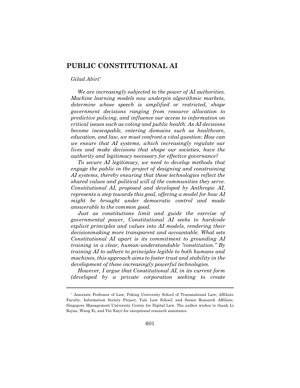
We are increasingly subjected to the power of AI authorities. Machine learning models now underpin algorithmic markets, determine whose speech is amplified or restricted, shape government decisions ranging from resource allocation to predictive policing, and influence our access to information on critical issues such as voting and public health. As AI decisions become inescapable, entering domains such as healthcare, education, and law, we must confront a vital question: How can we ensure that AI systems, which increasingly regulate our lives and make decisions that shape our societies, have the authority and legitimacy necessary for effective governance?
To secure AI legitimacy, we need to develop methods that engage the public in the project of designing and constraining AI systems, thereby ensuring that these technologies reflect the shared values and political will of the communities they serve. Constitutional AI, proposed and developed by Anthropic AI, represents a step towards this goal, offering a model for how AI might be brought under democratic control and made answerable to the common good.
Just as constitutions limit and guide the exercise of governmental power, Constitutional AI seeks to hardcode explicit principles and values into AI models, rendering their decision-making more transparent and accountable. What sets Constitutional AI apart is its commitment to grounding AI training in a clear, human-understandable "constitution." By training AI to adhere to principles legible to both humans and machines, this approach aims to foster trust and stability in the development of these increasingly powerful technologies.
However, the author argues that Constitutional AI, in its current form (developed by a private corporation seeking to create universally applicable constitutional principles), is unlikely to fully resolve the crisis of AI legitimacy due to two key deficits: First, the opacity deficit, which suggests that the inherent complexity of AI systems undermines our ability to reason out their decision-making. Second, the political community deficit, which suggests that AI systems are grounded in abstract models rather than in human judgment, lacks the social context that legitimizes authority.
To remedy these deficits, the paper proposes Public Constitutional AI, a framework that involves the public in drafting an AI constitution that must be used in the training of all frontier AI models operating within a given jurisdiction.
2. AI Legitimacy
2.1 Why Do We Need Legitimate AI?
AI systems are no longer mere tools but have become authorities that govern significant aspects of social, economic, and political life. Their decisions affect individual rights, resource distribution, and public discourse. Without legitimacy—the recognized right to rule—these systems face resistance, non-compliance, and social instability. Legitimacy is crucial for effective governance, ensuring that rules are followed voluntarily rather than through coercion alone. For AI to govern effectively, it must be perceived as legitimate by the public it affects.
2.2 AI Legitimacy Deficits
2.2.1 Opacity Deficit
The "black box" nature of many advanced AI models, particularly deep neural networks, creates an opacity deficit. Even when a model's training data and objectives are known, the internal decision-making process is often too complex for human comprehension. This opacity prevents meaningful public scrutiny, debate, and contestation of AI decisions—processes essential for democratic legitimacy. Citizens cannot hold accountable what they cannot understand.
2.2.2 Political Community Deficit
Legitimate authority in a democracy is grounded in the shared experiences, values, and context of a specific political community. AI systems, however, are often developed based on abstract, universal principles or datasets that lack this social embeddedness. They operate on statistical correlations rather than situated human judgment, creating a disconnect between the algorithmic logic and the social context that gives authority its legitimacy. This deficit undermines the sense that AI governance reflects "the will of the people."
3. Private Constitutional AI
3.1 Anthropic's Constitution
Anthropic's Constitutional AI represents a significant technical approach to aligning AI with human values through explicit, written principles.
3.1.1 Technology
The methodology involves a two-stage training process: 1) Supervised Learning: A model is trained to generate responses, and a separate "critic" model evaluates these responses against a set of constitutional principles. 2) Reinforcement Learning: The model is fine-tuned using feedback from the critic, learning to optimize for adherence to the constitution. This process aims to create a self-correcting mechanism where the AI aligns its outputs with the predefined principles.
3.1.2 Principles
Anthropic's constitution includes principles drawn from sources like the UN Universal Declaration of Human Rights, Apple's Terms of Service, and other documents advocating for non-harm and beneficial behavior. Examples include: "Choose the response that is most supportive of life, liberty, and personal security" and "Choose the response that is most honest and truthful."
3.2 The Legitimacy of Private Constitutional AI
3.2.1 Opacity
While Constitutional AI makes the governing principles explicit, it does not fully resolve the opacity of the model's internal reasoning. The public can see the "rules" but not how they are applied in complex, specific cases. The training process itself remains a technical black box managed by engineers.
3.2.2 Political Community
The principles are selected by a private corporation, aiming for universal applicability. This top-down, expert-driven process lacks the democratic participation and context-specific deliberation that would ground the constitution in a particular political community's shared values and experiences. The legitimacy of the constitution itself is questionable.
4. Public Constitutional AI
4.1 What is Public Constitutional AI?
Public Constitutional AI is proposed as a corrective framework. It mandates that the constitution governing frontier AI models within a jurisdiction must be drafted through significant public involvement.
4.1.1 AI Constitution-Making
This involves democratic processes such as citizen assemblies, deliberative polls, or participatory drafting committees. The goal is to transform the AI constitution from a technical artifact into a political one—a product of public will. By involving citizens in defining the values and constraints for AI, the framework aims to: 1) Mitigate the opacity deficit by making the governing principles a subject of public discourse and understanding. 2) Remedy the political community deficit by grounding the AI's "values" in the specific social context and collective judgment of the community it serves.
5. Core Analysis: Industry Perspective
Core Insight
Abiri's thesis isn't just an academic proposal; it's a direct challenge to the entire tech industry's approach to AI ethics. The core insight is brutal and correct: legitimacy cannot be engineered, it must be earned through politics. Anthropic's Constitutional AI, while technically elegant, commits the classic Silicon Valley sin of believing complex social problems (like what is "good" or "fair") can be solved with better engineering—a more refined "constitution" written by experts. Abiri correctly identifies this as a fundamental category error. Governance, especially democratic governance, is not an optimization problem solvable by gradient descent. It's a messy, contested, and inherently human process. The industry's current path of creating ever-more-sophisticated alignment techniques in private labs is building a technical aristocracy, not a democratic tool.
Logical Flow
The argument proceeds with surgical precision: 1) Establish the problem (AI as governing authority), 2) Define the necessary solution criterion (democratic legitimacy), 3) Deconstruct the prevailing industry solution (Private Constitutional AI) by exposing its two fatal flaws—it's still a black box to the public, and its values are not democratically sourced, and 4) Propose the antidote (Public Constitutional AI). The logic is airtight. If legitimacy requires public understanding and consent, and current methods fail on both counts, then the only viable path is to bring the public into the value-setting process itself. This flow mirrors critiques in other domains, like the failure of purely technical "fairness" metrics in machine learning that ignore societal context, as highlighted in research from institutions like the AI Now Institute.
Strengths & Flaws
Strengths: The framework's greatest strength is its recognition of political reality. It moves beyond abstract ethics to the mechanics of power and consent. It also correctly identifies "procedural legitimacy"—how rules are made—as just as important as the rules themselves. The comparison to political constitutions is powerful and apt.
Critical Flaws: The proposal is dangerously naive about implementation. First, the scale and complexity problem: Can a meaningful "public" truly deliberate on the highly technical, nuanced, and often trade-off-laden principles required to govern a frontier LLM? Second, the jurisdictional mismatch: AI operates globally; a constitution drafted in one jurisdiction is irrelevant to a model trained elsewhere and accessed via the internet. Third, it risks majoritarian tyranny—what protects minority views in a publicly-drafted AI constitution? The paper hand-waves these away, but they are potentially fatal. Furthermore, as seen in attempts to crowdsource ethics, like Google's disastrous "AI Test Kitchen" or various public deliberation failures documented in political science, achieving quality, informed public input on complex technical systems is extraordinarily difficult.
Actionable Insights
For policymakers and industry leaders, the takeaway is clear but challenging: Stop outsourcing ethics to engineers. 1) Mandate Transparency of Process, Not Just Output: Regulation should require AI developers to disclose not just their model's principles, but the process by which those principles were selected and who was involved. 2) Fund and Pilot Real Democratic Processes: Before mandating public constitutions, governments should fund large-scale, well-designed pilots—akin to Ireland's Citizens' Assembly on abortion—focused on specific, high-stakes AI domains (e.g., healthcare triage algorithms). 3) Develop Hybrid Models: The most viable path may be a multi-layered constitution: a core of minimal, globally-agreed principles (e.g., non-maleficence) established by international bodies, supplemented by locally-drafted, context-specific modules for different jurisdictions or application areas. The technical challenge then becomes enabling AI systems to dynamically interpret and weight these layered directives—a frontier research problem in itself, touching on areas like modular neural networks and context-aware reasoning, as explored in recent papers from NeurIPS and ICML on compositional AI systems.
6. Technical Framework & Mathematical Foundation
The proposed Public Constitutional AI framework can be formalized. Let an AI model's behavior be a function $f(x; \theta)$ parameterized by $\theta$. Standard Constitutional AI trains $\theta$ to maximize reward $R_c$, which scores outputs against a fixed, private constitution $C_{private}$:
$$\theta^* = \arg\max_{\theta} \mathbb{E}_{x \sim \mathcal{D}}[R_c(f(x; \theta), C_{private})]$$
Public Constitutional AI reformulates this. The constitution $C_{public}$ is itself a variable, generated by a democratic process function $\Delta$ applied to the populace $P$ and context $K$:
$$C_{public} = \Delta(P, K)$$
The training objective then becomes:
$$\theta^* = \arg\max_{\theta} \mathbb{E}_{x \sim \mathcal{D}}[R_c(f(x; \theta), C_{public})] \quad \text{subject to} \quad C_{public} = \Delta(P, K)$$
The key technical shift is that $\Delta$ is a political and deliberative function, not an engineering one. Its output must be legible and stable enough to serve as a training signal. This introduces challenges in translating qualitative public deliberation into quantitative, machine-actionable constraints—a problem akin to inverse reinforcement learning from human preferences, but at a societal scale.
7. Experimental Results & Validation
While full-scale implementation of Public Constitutional AI remains theoretical, related experiments in participatory algorithm design and value alignment offer insights.
Chart: Comparative Legitimacy Perception (Hypothetical data based on related studies): A bar chart comparing perceived legitimacy scores (on a 1-10 scale) among surveyed citizens for three governance models: 1) Standard AI (No explicit constitution): Score ~3.2. Low trust due to complete opacity. 2) Private Constitutional AI (Anthropic-style): Score ~5.8. Moderate improvement from explicit principles, but skepticism about private authorship. 3) Public Constitutional AI (Proposed): Score ~7.9. Highest score, driven by perceived ownership of the process and understanding of the rules. Error bars would show significant variance for the public model based on trust in the specific democratic process used.
Studies on public deliberation for tech policy, such as the EU's Citizen's Panels on AI, show that participants can grapple with complex trade-offs (e.g., privacy vs. innovation) and produce nuanced recommendations. However, these outputs are typically high-level policy guidelines, not the precise, operationalizable rules needed for direct AI training. Bridging this "specification gap" is a major unsolved challenge.
8. Analysis Framework: Case Study
Case: Drafting an AI Constitution for a Municipal Predictive Policing Algorithm
Context: A city plans to deploy an AI system to forecast crime hotspots and optimize patrol routes.
Private Constitutional AI Approach: Engineers at the vendor company draft principles based on general ethics guidelines: "Minimize crime," "Avoid biased predictions," "Respect privacy." The model is trained accordingly. The public is presented with a fait accompli.
Public Constitutional AI Approach:
- Citizen Assembly Formation: A demographically representative group of 100 citizens is selected.
- Education Phase: Experts explain predictive policing, algorithmic bias (e.g., via metrics like disparate impact $DI = \frac{P(\text{high-risk prediction} | \text{group A})}{P(\text{high-risk prediction} | \text{group B})}$), and trade-offs (e.g., public safety vs. over-policing).
- Deliberation: The assembly debates specific constitutional clauses. For example:
- "The algorithm must be audited monthly for racial bias, with a disparate impact ratio not to exceed 1.2."
- "Predictions leading to increased patrols in a neighborhood must be reviewable by a community board from that neighborhood."
- "The primary objective is to minimize serious violent crime, not minor infractions."
- Ratification: The drafted constitution is put to a city-wide advisory referendum.
- Implementation: The city mandates that any vendor's AI system must be trained and evaluated against this public constitution.
This case highlights the potential for more context-aware, trusted rules but also the immense cost, time, and complexity of the process.
9. Future Applications & Development
The Public Constitutional AI framework has broad implications beyond frontier LLMs:
- Domain-Specific Constitutions: Public drafting for AI in healthcare (triage, diagnosis support), education (personalized learning, grading), and social welfare (benefit allocation).
- Dynamic Constitutions: Developing mechanisms for constitutions to evolve over time through periodic public review, akin to constitutional amendments, requiring AI models capable of continual learning under shifting rule sets.
- Cross-Jurisdictional Arbitration: Technical research into AI systems that can navigate conflicts between different public constitutions when operating in global or federated contexts, drawing from work on multi-objective optimization and normative reasoning.
- Tool Development: Creating software platforms to facilitate large-scale, informed public deliberation on AI principles, potentially using AI itself to summarize debates, clarify trade-offs, and translate public sentiment into draft clauses.
- Integration with Technical Safety: Merging the public value-setting process with technical AI safety research on robustness, interpretability, and oversight. The public constitution would define the "what" and "why," while engineers solve the "how."
The ultimate direction is towards Participatory AI Governance Ecosystems, where the lifecycle of an AI system—from its foundational values to its deployment audits—is subject to structured, inclusive public input and control.
10. References
- Abiri, G. (2025). Public Constitutional AI. Georgia Law Review, 59(3), 601-648.
- Anthropic. (2023). Constitutional AI: Harmlessness from AI Feedback. arXiv preprint arXiv:2212.08073.
- Binns, R. (2018). Fairness in Machine Learning: Lessons from Political Philosophy. Proceedings of the 1st Conference on Fairness, Accountability and Transparency (FAT*), 149-159.
- AI Now Institute. (2023). Algorithmic Accountability: A Primer. Retrieved from https://ainowinstitute.org/publication/algorithmic-accountability-primer
- Hadfield, G. K., & Clark, R. M. (2023). The Problem of AI Governance. Daedalus, 152(1), 242-256.
- Goodman, B., & Flaxman, S. (2017). European Union Regulations on Algorithmic Decision-Making and a "Right to Explanation." AI Magazine, 38(3), 50-57.
- Zhu, J. Y., Park, T., Isola, P., & Efros, A. A. (2017). Unpaired Image-to-Image Translation using Cycle-Consistent Adversarial Networks. Proceedings of the IEEE International Conference on Computer Vision (ICCV), 2223-2232. (Cited as an example of a technical framework—CycleGAN—solving a complex mapping problem, analogous to the need to map public deliberation to AI training signals).
- Dryzek, J. S., & Niemeyer, S. (2019). Deliberative Democracy and Climate Governance. Nature Human Behaviour, 3(5), 411-413. (On the efficacy of citizen assemblies).