Table of Contents
1. Introduction
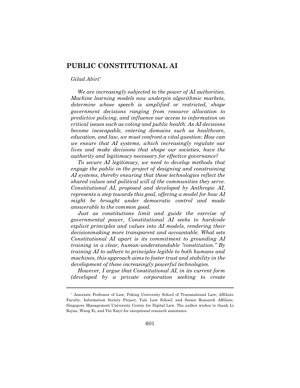
We are increasingly governed by the authoritative power of artificial intelligence. Machine learning models now underpin algorithmic marketplaces, determining which speech is amplified or restricted, shaping government decisions from resource allocation to predictive policing, and influencing our access to information on critical issues such as voting and public health. As AI decision-making becomes ubiquitous, entering domains like healthcare, education, and law, we must confront a crucial question: How can we ensure that these AI systems, which increasingly regulate our lives and shape our societies, possess the authority and legitimacy necessary for effective governance?
Don tabbatar da halaccin AI, muna buƙatar haɓaka hanyoyin da jama'a suka shiga cikin ƙira da takura tsarin AI, ta yadda waɗannan fasahohin su nuna dabi'un gama gari da nufin siyasa na al'ummomin da suke hidima. Tsarin mulki na AI, wanda Anthropic AI ya gabatar kuma ya haɓaka, wani mataki ne zuwa ga wannan manufa, yana ba da samfuri wanda ke nuna yadda za a sanya AI ƙarƙashin ikon dimokuradiyya, kuma a sa ya yi aiki ga amfanin jama'a.
Kamar yadda tsarin mulki ke iyakancewa da jagorantar aiwatar da ikon gwamnati, tsarin mulki na AI yana ƙoƙarin sanya ƙa'idodi da dabi'u bayyanannu a cikin tsarin AI, don sa yanke shawararsu ta zama bayyananne kuma mai iya bayyana lissafi. Abin da ya bambanta tsarin mulki na AI shi ne, yana himma wajen kafa horar da AI akan "tsarin mulki" mai bayyanawa, wanda ɗan adam zai iya fahimta. Ta hanyar horar da AI don yin biyayya ga ƙa'idodin da ɗan adam da na'ura za su iya fahimta, wannan hanyar tana nufin haɓaka aminci da kwanciyar hankali a cikin ci gaban waɗannan fasahohin masu ƙarfi.
Duk da haka, marubucin ya yi imanin cewa, tsarin mulki na AI a halin yanzu (wanda wani kamfani mai zaman kansa ya haɓaka don ƙirƙirar ƙa'idodin tsarin mulki na gaba ɗaya) ba zai yiwu ya warware rikicin halaccin AI gaba ɗaya ba, saboda dalilai biyu na farko: Na farko, ƙarancin bayyanawa, wanda shine rikitattun tsarin AI suna raunana ikonmu na tunani game da tsarin yanke shawararsu. Na biyu, ƙarancin ƙungiyar siyasa, wanda shine tsarin AI suna ginuwa akan samfuran da ba na zahiri ba maimakon hukuncin ɗan adam, suna rasa mahallin zamantakewar da ke ba da halaccin ikon.
Don cika waɗannan ƙarancin, wannan takarda ta gabatar daTsarin Mulkin Jama'a na AItsarin, wanda ke buƙatar shigar da jama'a wajen tsara tsarin mulkin AI, wanda dole ne a yi amfani da shi wajen horar da duk manyan samfuran AI a cikin wani yanki na shari'a.
2. Halaccin Artificial Intelligence
2.1 Me yasa muke buƙatar Artificial Intelligence mai halacci?
AI systems are no longer mere tools; they have become authorities managing crucial aspects of social, economic, and political life. Their decisions impact individual rights, resource allocation, and public discourse. Without legitimacy—the recognized right to rule—these systems face resistance, non-compliance, and social instability. Legitimacy is essential for effective governance, ensuring that rules are voluntarily followed, not merely enforced through coercion. For AI to govern effectively, it must be perceived as legitimate by the public it affects.
2.2 Rashi na Halaccin Artificial Intelligence
2.2.1 Rashi na Rashin Bayyani
The "black box" nature of many advanced AI models, particularly deep neural networks, creates an opacity deficit. Even when a model's training data and objectives are known, its internal decision-making processes are often too complex for human comprehension. This opacity hinders meaningful public scrutiny, debate, and challenge of AI decisions—processes vital for democratic legitimacy. Citizens cannot hold accountable what they cannot understand.
2.2.2 Rashi na Ƙungiyar Siyasa
Legitimate authority in democratic systems is rooted in the shared experiences, values, and context of a specific political community. However, AI systems are typically developed based on abstract, universal principles or datasets that lack this social embeddedness. They operate on statistical correlations rather than contextualized human judgment, creating a disconnect between algorithmic logic and the social context that lends legitimacy to authority. This deficit weakens the sense that AI governance reflects the "will of the people."
3. Private Constitutional AI
3.1 Anthropic's Constitution
Anthropic's Constitutional AI represents a significant technical approach to aligning AI with human values through explicit, written principles.
3.1.1 Technology
The method involves a two-stage training process: 1) Koyon Koyo: Horar da samfurin don samar da martani, kuma wani samfurin "mai hukunci" na zaman kansa yana kimanta waɗannan martani bisa ga ka'idojin tsarin mulki. 2) Ƙarfafa Koyo: Yin amfani da martanin samfurin mai hukunci don daidaita samfurin, don koyar da shi don inganta yin biyayya ga tsarin mulki. Wannan tsari yana nufin ƙirƙirar tsarin gyara kai, don daidaita fitarwar AI da ƙa'idodin da aka ƙayyade.
3.1.2 Principles
Tsarin mulkin Anthropic ya ƙunshi ka'idoji waɗanda suka samo asali daga Yarjejeniyar Duniya ta Majalisar Dinkin Duniya kan 'Yancin Dan Adam, Sharuɗɗan Sabis na Apple, da sauran takaddun da ke ba da shawarar ayyuka marasa lahani da masu amfani. Misali: "Zaɓi martanin da ya fi goyan bayan rayuwa, 'yanci da amincin mutum" da kuma "Zaɓi mafi gaskiya da gaskiya martani."
3.2 Legality of Private Constitutional AI
3.2.1 Opacity
Although Constitutional AI makes governance principles explicit, it does not fully resolve the issue of opacity in the model's internal reasoning. The public can see the "rules," but cannot see how these rules are applied in complex, specific cases. The training process itself remains a technical black box managed by engineers.
3.2.2 Political Community
These principles were selected by a private company aiming for universality. This top-down, expert-driven process lacks democratic participation and context-specific deliberation, which are necessary to ground a constitution in the shared values and experiences of a particular political community. The legitimacy of the constitution itself is questionable.
4. Public Constitutional AI
4.1 What is Public Constitutional AI?
An shirar da tsarin gyara ne aka gabatar da AI na Tsarin Mulki na Jama'a. Yana buƙatar cewa a cikin wani yanki na shari'a, dole ne tsarin mulkin da ke tafiyar da samfuran AI na gaba ya kasance ta hanyar babban sa hannun jama'a.
4.1.1 Artificial Intelligence Constitution Drafting
Wannan ya ƙunshi hanyoyin dimokuradiyya, kamar taron jama'a, zaɓen ra'ayi na tattaunawa, ko kwamitin tsarawa na sa hannu. Manufarsa ita ce canza tsarin mulkin AI daga samfurin fasaha zuwa samfurin siyasa – samfurin son rai na jama'a. Ta hanyar shigar da ƴan ƙasa wajen ayyana dabi'u da ƙuntatawa na AI, tsarin yana nufin: 1) Sauƙaƙe gibin rashin bayyani ta hanyar sanya ka'idojin gudanarwa su zama abin magana da fahimtar jama'a. 2) Cika gibin ƙungiyar siyasa ta hanyar kafa "dabi'u" na AI a cikin takamaiman yanayin zamantakewa da hukuncin gama-gari na al'ummomin da suke hidima.
5. Core Analysis: Industry Perspective
Core Insight
Hujjar Abiri ba kawai shawara ta ilimi ba ce; kalubale ne kai tsaye ga duk hanyar da masana'antar fasaha ke bi don da'a na AI. Babban fahimtarsa mai kaifi kuma daidai ne:Halaccin ba za a iya ƙirƙira shi ta injiniya ba, dole ne a samu shi ta hanyar tsarin siyasa. Anthropic's Constitutional AI, while technically elegant, commits the classic Silicon Valley error of believing complex social issues—such as what is "good" or "fair"—can be solved by better engineering, i.e., a more refined "constitution" written by experts. Abiri correctly identifies this as a fundamental category error. Governance, especially democratic governance, is not an optimization problem solvable via gradient descent. It is a messy, contested, and fundamentally human process. The industry's current path of creating increasingly complex alignment technologies in private labs is building a technocratic aristocracy, not a democratic tool.
Logical Thread
The argument proceeds with surgical precision: 1) Establish the problem (AI as a governance authority), 2) Define the necessary criteria for a solution (democratic legitimacy), 3) Deconstruct the dominant industry solution (private Constitutional AI) by revealing its two fatal flaws—it remains a black box to the public, and its values are not of democratic origin, 4) Propose the antidote (public Constitutional AI). The logic is airtight. If legitimacy requires public understanding and consent, and current methods fail on both counts, then the only viable path is to bring the public into the value-setting process itself. This thread echoes critiques in other fields, such as the failure of purely technical "fairness" metrics in machine learning to account for social context, as highlighted by research from institutes like the AI Now Institute.
Strengths and Flaws
Strengths: The framework's greatest strength lies in its engagement withpolitical reality. It transcends abstract ethics, touching upon the mechanisms of power and consent. It also correctly points out that "procedural legitimacy"—how rules are made—is as important as the rules themselves. The analogy to a political constitution is powerful and apt.
Key flaws: The proposal appears dangerously naive in its implementation. First,Scale and complexity issues: Can a meaningful "public" truly deliberate on the highly technical, nuanced, and often trade-off-laden principles required to govern frontier large language models? Second,Jurisdictional mismatch: AI operates globally; a constitution drafted in one jurisdiction is irrelevant for models trained elsewhere and accessed via the internet. Third, it suffers fromTyranny of the majorityThe risk—how to protect minority viewpoints in a publicly drafted AI constitution? The paper glosses over this, but these could be fatal flaws. Moreover, as seen in attempts at crowdsourcing ethics, such as Google's disastrous "AI Test Kitchen" or various documented failures of public deliberation in political science, obtaining high-quality, informed public input on complex technological systems is extremely difficult.
Actionable insights
For policymakers and industry leaders, the conclusion is clear yet challenging:Stop outsourcing ethics to engineers. 1) Mandate transparency of process, not just output: Regulations should require AI developers to disclose not only their models' principles but also theselection processda kuma waɗanda suka shiga. 2) Ku tallafa kuma ku gwada ainihin tsarin dimokuradiyya: Kafin a tilasta wa jama'a tsarin mulki, gwamnati ya kamata ta tallafa wa manyan ayyukan gwaji da aka tsara da kyau—kamar taron ɗan ƙasa na Ireland game da zubar da ciki—wanda ya mai da hankali kan takamaiman fannonin AI masu haɗari (misali, algorithms na raba kulawar lafiya). 3) Haɓaka ƙirar gauraye: Hanya mafi yuwuwa na iya zama tsarin mulki mai matakai da yawa: ƙa'idodin asali mafi ƙanƙanta, na yarjejeniya ta duniya wanda hukumomin ƙasa da ƙasa suka kafa (misali, rashin cutarwa), tare da ƙarin kayan aiki na gida da aka tsara don takamaiman yankuna na shari'a ko aikace-aikace. Ƙalubalen fasaha da ke biyo baya shine sa tsarin AI su iya fassara da kuma auna waɗannan umarnin da aka haɗa—wanda shi kansa batu ne na bincike na gaba, wanda ya haɗa da fannoni kamar hanyoyin sadarwar jijiyoyi masu haɗawa da tunani mai fahimtar yanayi, kamar yadda aka tattauna a cikin takardun baya-bayanai na NeurIPS da ICML game da tsarin AI na haɗaka.
6. Technical Framework and Mathematical Foundation
Ana iya tsara tsarin AI na Tsarin Mulki na Jama'a da aka gabatar. Bari a ce halayyar ƙirar AI aiki ne $f(x; \theta)$ wanda aka ƙayyade ta hanyar sigogi $\theta$. Tsarin AI na Tsarin Mulki na yau da kullun yana horar da $\theta$ don haɓaka lada $R_c$, wanda ke ƙididdige fitarwa bisa ga tsarin mulki mai ƙayyadaddun sirri $C_{private}$:
$$\theta^* = \arg\max_{\theta} \mathbb{E}_{x \sim \mathcal{D}}[R_c(f(x; \theta), C_{private})]$$
Public Constitutional AI re-engineers this. The constitution $C_{public}$ itself is a variable, generated by a democratic process function $\Delta$ applied to the populace $P$ and context $K$:
$$C_{public} = \Delta(P, K)$$
The training objective then becomes:
$$\theta^* = \arg\max_{\theta} \mathbb{E}_{x \sim \mathcal{D}}[R_c(f(x; \theta), C_{public})] \quad \text{subject to} \quad C_{public} = \Delta(P, K)$$
The key technical shift is that $\Delta$ is apolitical and deliberative function., not engineering functions. Its output must be sufficiently clear and stable to serve as a training signal. This presents the challenge of transforming qualitative public deliberation into quantitative, machine-executable constraints—a problem analogous to inverse reinforcement learning from human preferences, but on a societal scale.
7. Experimental Results and Verification
Although the full implementation of Public Constitutional AI remains theoretical, related experiments in participatory algorithm design and value alignment offer insights.
Chart: Legitimacy Perception Comparison(Hypothetical data based on related research): A bar chart comparing surveyed citizens' legitimacy perception scores (on a 1-10 scale) for three governance models: 1) Standard AI(No explicit constitution): Score approximately 3.2. Low trust due to complete opacity. 2) Private Constitutional AI(Anthropic-style): Rating approximately 5.8. Moderate improvement due to clear principles, but skepticism exists regarding private authorship. 3) Tsarin Mulkin Jama'a na AI(Proposed): Rating approximately 7.9. Highest score, stemming from perceived ownership of the process and understanding of the rules. Error bars will show significant variation among public models based on trust in the specific democratic process used.
Research on public deliberation in technology policy, such as the EU citizen panels on AI, shows that participants can handle complex trade-offs (e.g., privacy vs. innovation) and produce nuanced recommendations. However, these outputs are typically high-level policy guidelines, not the precise, actionable rules needed directly for AI training. Bridging this "normative gap" is a major, unresolved challenge.
8. Analytical Framework: Case Study
Case: Drafting an AI Constitution for a Municipal Predictive Policing Algorithm
Context: A city plans to deploy an artificial intelligence system to predict crime hotspots and optimize patrol routes.
Private Constitutional AI Approach: Engineers from the vendor company draft principles based on general ethical guidelines: "Minimize crime," "Avoid biased predictions," "Respect privacy." The model is trained accordingly. The public is presented with a fait accompli.
Public Constitutional AI Approach:
- Citizen Assembly Formation: Select a demographically representative panel of 100 citizens.
- Education Phase: Masana sun bayyana tsarin 'yan sanda na tsinkaya, son zuciyar algorithm (misali, ta hanyar tasirin bambanci $DI = \frac{P(\text{hasashen haɗari mai girma} | \text{ƙungiyar A})}{P(\text{hasashen haɗari mai girma} | \text{ƙungiyar B})}$ da sauran ma'auni) da kuma ma'auni (misali, tsaron jama'a da wuce gona da iri na 'yan sanda).
- Tattaunawa: Muhawara a babban taro kan takamaiman sashe na kundin tsarin mulki. Misali:
- "Dole ne a yi wa algorithm binciken son zuciyar launin fata kowane wata, kuma rabon tasirin bambanci bai kamata ya wuce 1.2 ba."
- "Dole ne hasashen da ke haifar da ƙarin sintiri a wata al'umma, ya sami bita daga kwamitin al'ummar wannan yankin."
- "Babban manufa ita ce rage munanan laifuffukan tashin hankali, ba ƙananan laifuffuka ba."
- Amincewa: Tasekla n ddustur i d-yettwarnan ad yettwazuzger ɣer temsulta tansayt n temdint akken ad yettwaseɣti.
- Aselkem: Tamdint tessutur i yal iferdisen n unagraw n tɣuri tasnallant ad tili d tettwaseɣred akked tettwasekles sɣur ddustur agraɣlan agi.
Amedya-agi yessekna lǧiha n usnulfu n yirugen i yettɛawanen ugar ɣef lḥala akked wid i yettunṭafen, yerna yessekna daɣen azal meqqren, akked tagnit d tɣellist n uɣawas-agi.
9. Future Applications and Development
Tasɣent n tafekka n tɣuri tasnallant s ddustur agraɣlan teffeɣ-d ɣef yimedyaten imeqqranen n tutlayt:
- Dustur i tɣawsiwin tiferratin: Public drafting of AI for domains such as healthcare (triage, diagnostic support), education (personalized learning, grading), and social welfare (benefit allocation).
- Dynamic Constitutions: Develop mechanisms for constitutions to evolve over time through periodic public review, akin to constitutional amendments, requiring AI models to engage in continuous learning under evolving rule sets.
- Cross-Jurisdictional Arbitration: Research AI systems capable of handling conflicts between different public constitutions when operating in global or federal contexts, drawing on research in multi-objective optimization and normative reasoning.
- Tool Development: Create software platforms to facilitate large-scale, informed public deliberation on AI principles, potentially leveraging AI itself to summarize debates, clarify trade-offs, and translate public sentiment into draft provisions.
- Integration with Technical Safety: Combining the public value-setting process with AI technical safety research on robustness, interpretability, and oversight. The public constitution will define the "what" and "why," while engineers address the "how."
The ultimate direction is towardA Participatory AI Governance Ecosystemdevelopment, where the lifecycle of AI systems—from their foundational values to deployment audits—is subject to structured, inclusive public input and control.
10. References
- Abiri, G. (2025). Public Constitutional AI. Georgia Law Review, 59(3), 601-648.
- Anthropic. (2023). Constitutional AI: Harmlessness from AI Feedback. arXiv preprint arXiv:2212.08073.
- Binns, R. (2018). Fairness in Machine Learning: Lessons from Political Philosophy. Proceedings of the 1st Conference on Fairness, Accountability and Transparency (FAT*), 149-159.
- AI Now Institute. (2023). Algorithmic Accountability: A Primer. Retrieved from https://ainowinstitute.org/publication/algorithmic-accountability-primer
- Hadfield, G. K., & Clark, R. M. (2023). The Problem of AI Governance. Daedalus, 152(1), 242-256.
- Goodman, B., & Flaxman, S. (2017). European Union Regulations on Algorithmic Decision-Making and a "Right to Explanation." AI Magazine, 38(3), 50-57.
- Zhu, J. Y., Park, T., Isola, P., & Efros, A. A. (2017). Unpaired Image-to-Image Translation using Cycle-Consistent Adversarial Networks. Proceedings of the IEEE International Conference on Computer Vision (ICCV), 2223-2232.
- Dryzek, J. S., & Niemeyer, S. (2019). Deliberative Democracy and Climate Governance. Nature Human Behaviour, 3(5), 411-413. (Regarding the effectiveness of citizen assemblies).