Table of Contents
1. Introduction & Overview
In the API Economy, RESTful APIs have transitioned from technical interfaces to core business assets. While the OpenAPI Specification (OAS) has successfully standardized the functional description of APIs, a critical gap remains in modeling their non-functional business aspects, specifically pricing plans and service limitations (quotas, rates). This paper introduces Pricing4APIs, a rigorous model designed to formally define API pricing structures, and SLA4OAI, its serialization as an extension to OAS. The work addresses the lack of standardization that hinders tool development for capacity analysis, cost estimation, and SLA compliance.
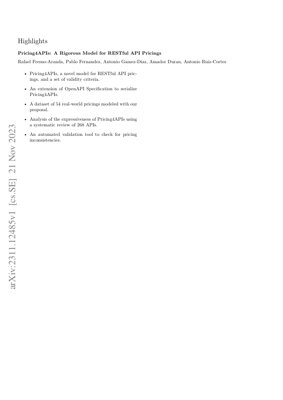
268 APIs
Analyzed for expressiveness
54 Models
Real-world pricing datasets created
1 Tool
Automated validation (sla4oai-analyzer)
2. The Pricing4APIs Model
Pricing4APIs provides a formal, machine-readable model to describe the multi-tiered pricing plans commonly used in API monetization (e.g., Free, Basic, Premium).
2.1 Core Components & Structure
The model is built around key entities: Pricing Plans (tiers), Limitations (quotas, rates, throttling rules), and Cost Structures. A plan can have multiple limitations, which are defined over specific time windows (e.g., 1000 requests/month, 50 req/second). The model supports complex, nested limitations essential for real-world scenarios.
2.2 SLA4OAI: The OAS Extension
To ensure practical adoption, the model is serialized as SLA4OAI, an extension to the OpenAPI Specification. This allows API providers to embed pricing and SLA information directly into their existing OAS documents using custom fields (e.g., x-sla4oai-pricing), making the information discoverable and processable by the existing OAS tooling ecosystem.
3. Validation & Tooling
A core contribution is the definition of a validation operation to check pricing models for logical consistency and potential conflicts.
3.1 Validation Operation
The validation operation checks for issues such as overlapping rate limits, contradictory quotas, or plans that are mathematically impossible to fulfill (e.g., a daily quota lower than an hourly rate limit could create an unreachable state).
3.2 sla4oai-analyzer Tool
The authors developed sla4oai-analyzer, an open-source tool that automates this validation. It parses OAS files extended with SLA4OAI definitions and outputs a report of any inconsistencies, helping API designers avoid flawed pricing schemes before deployment.
4. Empirical Analysis & Results
The framework's utility was evaluated through extensive empirical research.
4.1 Expressiveness Study (268 APIs)
A systematic review of 268 real-world public APIs was conducted. The study aimed to determine if Pricing4APIs could model the diverse pricing structures found in practice. The results demonstrated high expressiveness, successfully capturing the limitations (quota, rate, geographic, feature-based) used by major providers like Google Maps, Stripe, and Twilio.
Chart Insight: A hypothetical bar chart from this study would show the frequency of different limitation types (Quota, Rate, Feature-Flag) across the 268 APIs, with Quota being the most prevalent (~85%), followed by Rate Limiting (~60%).
4.2 Dataset of 54 Real-World Pricings
From the larger set, a curated dataset of 54 API pricing models was created and formally modeled using Pricing4APIs. This dataset serves as a benchmark for future research and tool development in API economics and management.
5. Technical Framework & Details
The model's formalism allows for precise calculations. For instance, the maximum theoretical throughput $R_{max}$ for a plan with a rate limit $L_r$ (requests per second) and a quota $Q$ (requests per month) can be constrained as:
$R_{max} = \min(L_r, \frac{Q}{T_m})$
where $T_m$ is the number of seconds in the billing period. This simple formula highlights how conflicting limits can cap performance unexpectedly. The validation tool checks for such constraints dynamically.
6. Analysis Framework Example
Case: Analyzing a Hypothetical Weather API Pricing Plan
Plan: "Professional" Tier
Limitations defined in SLA4OAI format:
    x-sla4oai-pricing:
      plans:
        - name: Professional
          limitations:
            - type: quota
              metric: requests
              value: 10000
              window: P1M  # Monthly
            - type: rate
              metric: requests
              value: 10
              window: PT1S # Per Second
            - type: feature
              name: historical_data
              enabled: true
Analysis using Pricing4APIs concepts: The sla4oai-analyzer would validate this plan. It would calculate that the monthly quota allows for an average rate of ~0.0038 req/s, which is far below the 10 req/s rate limit. This is not an inconsistency but an important characteristic: the rate limit only becomes a bottleneck if a user attempts sustained high-volume usage early in the month. The tool would flag this for designer review, prompting a decision: is the 10 req/s limit practically relevant, or should it be lowered to align with the quota?
7. Future Applications & Directions
The standardization proposed by Pricing4APIs opens several avenues:
- Automated API Marketplace Comparisons: Tools could automatically compare cost-efficiency across providers for specific usage patterns.
- Intelligent API Gateways: Gateways could dynamically enforce complex, multi-window limits defined in SLA4OAI, beyond simple rate limiting.
- Cost-Optimization & "Right-Tiering" Assistants: For consumers, agents could monitor usage and recommend plan upgrades/downgrades based on modeled limits and predictions.
- Integration with Billing Systems: Direct generation of billing logic from the machine-readable pricing model.
- Extension to GraphQL & gRPC: While focused on REST, the core concepts are applicable to other API paradigms, representing a clear future direction.
8. References
- Zhu, J., Park, T., Isola, P., & Efros, A. A. (2017). Unpaired Image-to-Image Translation using Cycle-Consistent Adversarial Networks. ICCV. (Cited as an example of a formal model driving tooling ecosystems in machine learning).
- OpenAPI Initiative. (2023). OpenAPI Specification. https://spec.openapis.org/oas/v3.1.0
- Fresno-Aranda, R., et al. (2023). Pricing4APIs: A Rigorous Model for RESTful API Pricings. arXiv:2311.12485.
- ProgrammableWeb. (2023). API Directory. https://www.programmableweb.com/ (Implied source for the 268 API study).
Core Insights & Analyst Perspective
Core Insight: Fresno-Aranda et al. have identified and attacked a fundamental flaw in the API Economy's infrastructure: the lack of a standardized, machine-readable language for pricing. While OAS solved the "how to call it" problem, Pricing4APIs aims to solve the "how much does it cost and what do I get" problem. This isn't just an academic exercise; it's a prerequisite for the next level of automation in API consumption and management.
Logical Flow: The paper's logic is compelling. It starts with the observed gap (no pricing standard), proposes a formal model (Pricing4APIs) to fill it, provides a practical serialization (SLA4OAI) for immediate use, and then validates the whole approach with empirical data (268 APIs) and functional tooling (the analyzer). This mirrors the successful playbook of projects like CycleGAN, which proposed a novel formal framework (cycle consistency) and then demonstrated its utility across multiple domains, thereby driving adoption.
Strengths & Flaws: The major strength is the direct tackle of a real, painful industry problem with a practical solution that leverages the existing OAS ecosystem—a smart adoption strategy. The creation of a validation tool and a public dataset are significant value-adds that lower the barrier to entry for other researchers and developers. The primary flaw, acknowledged in the future work, is the initial REST/OAS focus. The API world is moving towards GraphQL and gRPC, and pricing models for these paradigms can be even more complex (e.g., per-field or per-complexity pricing). The model may need significant extension to remain relevant.
Actionable Insights: For API providers, the takeaway is clear: start documenting your pricing plans in a structured format now. Using an extension like SLA4OAI, even internally, can uncover costly logical errors in your tier design before customers do. For enterprises consuming APIs, advocate for providers to adopt such standards. The ability to programmatically compare and optimize across dozens of SaaS APIs could lead to substantial cost savings. The research community should treat the provided dataset as a benchmark for future work on API economics and management automation. The real test will be if major API management platforms (Apigee, Kong) begin to support this or a similar specification natively.